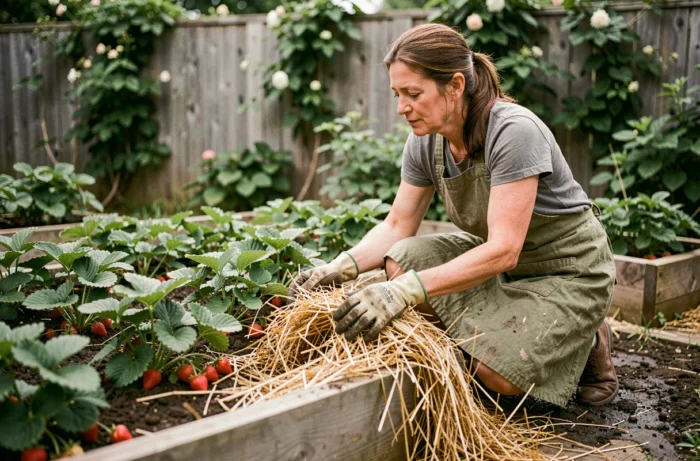
The mulching of strawberry plants is not limited to placing straw under the fruits to avoid contact with the soil. When done correctly, it modifies the water balance of the plot to the point of halving the frequency of watering during the height of summer. Here, we detail the mechanisms at play and the choices of materials that truly make a difference in water consumption.
Pre-watering before mulching: the prerequisite that most guides overlook
Applying mulch on dry soil is like isolating an empty reservoir. Deep pre-watering before laying down the mulch conditions the entire effectiveness of the system. We recommend saturating the top twenty centimeters of soil, where the majority of the strawberry plants’ root system is concentrated.
This deep moistening creates a useful reserve that the mulch will then protect from evaporation. Without this step, the mulch layer traps superficial moisture without feeding the roots. The strawberry plant, whose water needs increase significantly between flowering and harvest, then draws from an insufficient stock.
Field reports show that some gardeners go from seven weekly waterings to two by combining deep watering and thick mulching, representing a reduction in frequency of more than half. To delve deeper into the mulching techniques on Jardiner Naturellement, this approach is detailed with variations depending on soil types.
Thickness and structure of the mulch: direct effect on moisture retention
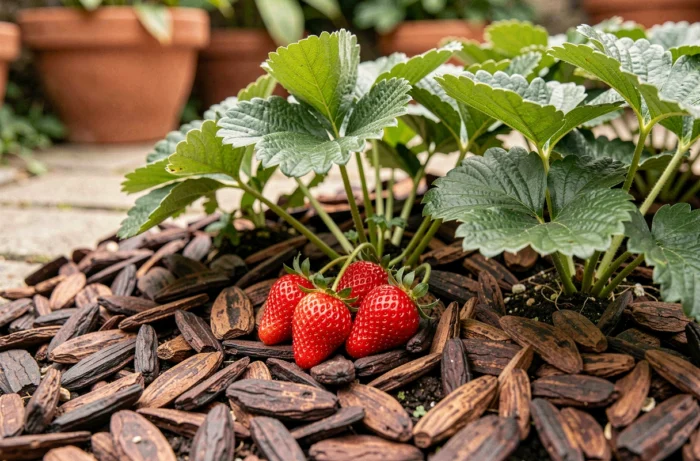
The thickness of the mulch determines the soil’s ability to retain water. A minimum of seven centimeters is necessary to significantly slow evaporation during the summer. Below this, the sun penetrates the material, and the soil dries out almost as quickly as if it were bare.
The structure of the mulch is just as important as its thickness. A material that is too compact (freshly mowed grass clippings, flattened dead leaves) forms an impermeable crust that prevents watering or rainwater from infiltrating. Water runs off the surface without reaching the roots.
Conversely, an airy mulch allows water to penetrate while limiting upward evaporation. Wheat or barley straw, partially decomposed wood chips, and dry ferns meet this requirement. We observe that heterogeneous particle size (a mix of long fibers and short fragments) creates micro-pockets of air that slow thermal exchanges with the atmosphere.
Managing the layer during the season
Organic mulch compresses and decomposes. After six to eight weeks, the effective thickness decreases, and water protection diminishes. Regularly topping up maintains the coverage at its useful threshold. This replenishment often coincides with the onset of heat waves, a time when strawberry plants are most vulnerable to water stress.
Sheep wool and reflective mulches: underappreciated materials for strawberries
Classic articles focus on straw, bark, and woven fabric. Two materials deserve special attention for their effect on reducing watering.
Sheep wool in mats, laid in an airy layer of five to ten centimeters on already moist soil, offers a high water retention capacity. Recent trials report up to 30% less watering under certain summer growing conditions. The wool absorbs excess water during applications and slowly releases it back to the soil, a buffering effect that regular straw does not provide.
- Sheep wool retains water in its fibers and releases it gradually, smoothing out moisture variations at the root level.
- Light mineral mulches (crushed slate, limestone gravel) reflect some solar radiation and reduce soil heating, which limits evaporation even with a thin layer.
- Fragmented branch wood chips (BRF), rich in lignin, decompose slowly and nourish soil life, improving structure and long-term water retention capacity.

Each material imposes a compromise. Wool is more expensive and sometimes attracts birds that take it for their nests. BRF mobilizes nitrogen during its initial decomposition, which can temporarily slow down the growth of runners. The choice of mulch depends on the soil, local climate, and the frequency of maintenance that can be envisioned.
Mulching and water distribution method: coupling drip irrigation and mulch
Mulching without adapting the watering method means losing part of the benefit. Traditional spraying moistens the surface of the mulch, which absorbs a fraction of the water before it reaches the soil. On a thick straw mulch, this loss can represent a significant portion of the volume applied.
Drip irrigation placed under the mulch distributes water directly at soil level, without loss due to interception or evaporation from the surface of the mulch. This setup combines two effects: the reduction of evaporation by the mulch and the optimization of useful volume through drip irrigation.
We recommend positioning the soaker hose or drip line before installing the mulch. The flow should be low to encourage lateral infiltration in the top centimeters, where the feeder roots of the strawberry plant are densest. A slow watering of one to two hours effectively replaces two quick passes with a hose.
Watering frequency under mulch in peak season
On a well-mulched clay-loam soil with buried drip irrigation, two weekly applications are generally sufficient, even during heat peaks. On sandy soil, which drains faster, three applications are often necessary. The finger test under the mulch at ten centimeters deep remains the best indicator: if the soil sticks slightly, watering can wait.
Mulching strawberries does not act alone. It fits into a set of practices (prior deep watering, choice of material suited to the climate, coupling with an efficient distribution system) that, combined, transform the water management of a strawberry bed. Every link counts, and it is their articulation that produces measurable water savings over an entire season.