
An electric radiator displays 1000 W on its label, and the question arises: what temperature will we achieve in the room or in the pot? We are looking for a direct equivalence, a simple table. The problem is that watts and degrees Celsius measure two distinct quantities: power on one side, temperature on the other. Converting from one to the other requires knowing what is being heated, how long, and what is lost along the way.
Thermal resistance and stabilized regime: the often-forgotten data
In the results found online, the classic formula Q = m × c × ΔT consistently appears. It works for a closed system, but we rarely operate in a perfect calorimeter. In home heating or cooking, a significant portion of the energy escapes through convection, radiation, or conduction to the support.
For electronic components and dissipation systems, we prefer the concept of thermal resistance (in °C/W). The relationship becomes ΔT = P × Rθ, where Rθ depends on the design of the device and the cooling conditions. A heat-retaining radiator and a convection heater of the same power do not produce the same surface temperature because their thermal resistance differs.
This approach explains why two 1000 W devices installed in the same room can yield very different results. Understanding how to convert 1000 watts to degrees Celsius requires considering the insulation of the home, the volume of air, and the type of radiator used.

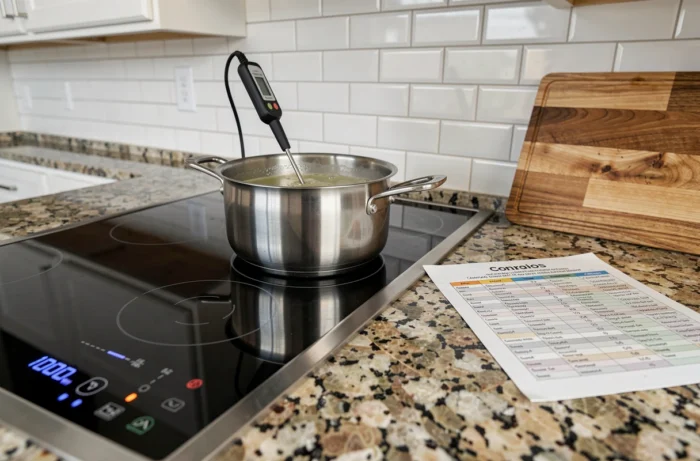
Estimation formula for heating water at 1000 watts
Water is the simplest case to illustrate the link between power and temperature rise. Its specific heat capacity is well documented. We combine two formulas:
- The energy supplied by the device: Q = P × t, which is power multiplied by time in seconds
- The temperature rise of the liquid: ΔT = Q / (m × c), where m is the mass of water and c is its specific heat
- By combining the two: ΔT = (P × t) / (m × c), which gives the theoretical temperature difference under ideal conditions
With a 1000 W device and one liter of water, we achieve a noticeable temperature rise in a few minutes. In real conditions, thermal losses (steam, conduction to the container, ambient convection) reduce the result. The final temperature will always be lower than the theoretical value.
Why duration changes everything
Power alone does not set the temperature. It is the power-duration pair that determines the total energy injected. A 1000 W device turned on for ten seconds heats almost nothing. The same device for an hour provides a sufficient amount of energy to theoretically boil several liters of water.
The nominal power is not a constant heating power. An oven, for example, alternates between heating and maintaining cycles via its thermostat. The actual consumption over an hour is often lower than what the nameplate indicates.
Estimating the temperature of a room with a 1000 W electric radiator
In home heating, the situation becomes more complicated. We are no longer heating a volume of water in a container, but air in a room open to losses. The insulation of the walls, the quality of the windows, the air renewal, and the delta between the outside temperature and the desired temperature play a direct role.
An empirical rule circulates in the trade: for a properly insulated home, we count about 100 W per square meter of surface. A 1000 W radiator would then be suitable for a room of about ten square meters. However, this estimate only holds for standard insulation and a typical ceiling height.
- A poorly insulated room (single glazing, uninsulated walls) may require double the power to reach the same temperature
- A recent home built to current thermal standards requires significantly less power per square meter
- The outside temperature directly influences the thermal delta: the colder it is outside, the harder the radiator struggles to maintain the setpoint
One cannot deduce a precise temperature from 1000 W without knowing the building. Feedback varies on this point depending on the age of the home and the region.
Convector, radiant panel, or inertia: the device matters
At the same power level, an electric convector quickly pushes warm air but creates temperature differences between the floor and the ceiling. An inertia radiator (cast iron, ceramic, heat transfer fluid) accumulates heat and releases it more evenly. The radiant panel heats surfaces and bodies directly, without primarily heating the air.
The choice of radiator type modifies the comfort felt at the same temperature. A radiant panel can provide a comparable warmth sensation with one or two degrees less on the thermometer, which reduces actual consumption.
Why direct conversion from watts to degrees does not exist
The watt measures a flow of energy per second. The degree Celsius measures a thermal state. Seeking a direct conversion is akin to asking how many kilometers ten liters of gasoline will yield: the answer depends on the vehicle, the road, and the driver.
To estimate a temperature from a power, we always need intermediate variables: the mass or volume being heated, the thermal capacity of the material, the duration of operation, and the thermal losses to the environment. Without this data, no serious calculation is possible.
The most reliable reflex remains to start from the concrete situation: what object or space, what insulation, what heating duration. The formula ΔT = (P × t) / (m × c) provides an order of magnitude under ideal conditions. Real losses then require revising the figure downward, sometimes significantly depending on the quality of the installation.


