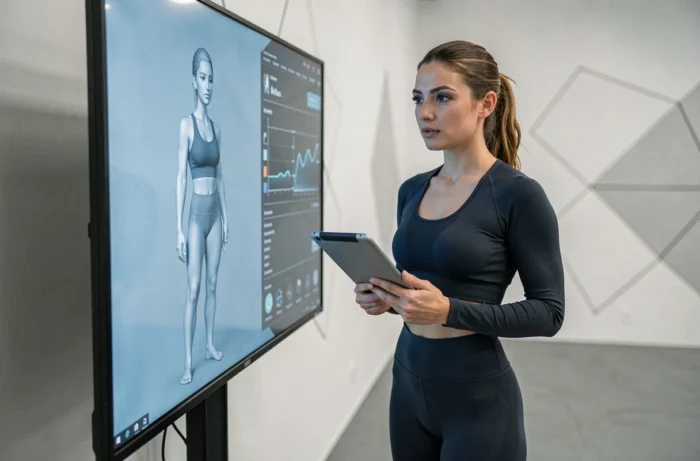
Creating a virtual silhouette that accurately reflects one’s measurements is no longer just about entering three numbers into a form. Recent tools aim to model the concrete discrepancies between the body and clothing by integrating parameters that simple morphological categories (hourglass, pear, rectangle) do not capture. It remains to understand what truly distinguishes these approaches and what they measure.
Smartphone scan, manual entry, or 3D booth: precision gaps
The choice of capture method directly determines the reliability of the result. Not all methods are equal, and the difference is not just about price.
| Method | Estimated Precision | Main Limitations |
|---|---|---|
| Manual entry (measuring tape) | Correct for circumferences, low for volumes | Positioning error of the tape, no consideration of posture |
| Smartphone application (photos) | Good for general morphology | Sensitive to lighting, clothing worn, and distance |
| 3D scanning booth | Very high | Available only in a few major cities, cost per session |
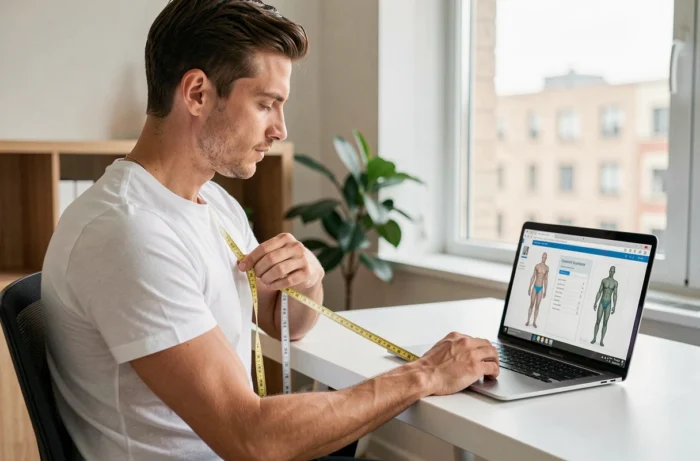
Manual entry remains the most accessible. However, it only captures perimeters (bust, waist, hip measurements) without modeling the distribution of volumes or body asymmetries.
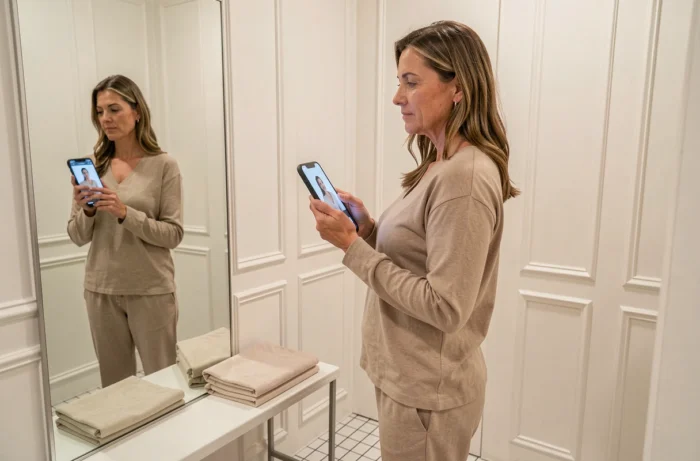
Computer vision-based systems via smartphone are making significant progress. Their main weakness lies in the shooting conditions: loose clothing, backlighting, or a slightly off posture can distort the modeling. Using a silhouette simulator with measurements already allows for a visualization close to reality, provided that the initial measurement process is done carefully.
Posture and asymmetries: what morphological categories do not show
Traditional classifications (hourglass, triangle, rectangle) compare three measurements: bust, waist, hips. They answer a simple question: what is my general shape? They do not answer a more useful question: why does this garment not fit me properly.
Feedback from professionals in tailoring and bespoke services published recently emphasizes a specific point. An accurate silhouette primarily serves to identify postural peculiarities: anterior pelvic tilt, asymmetrical shoulders, pronounced curvature. These elements directly influence the fit of a garment, much more than the simple morphological category.
Pants that sag at the back, a jacket that pulls on one shoulder, a skirt that twists at the hips: these recurring issues are not explained by a poor size choice. They stem from a discrepancy between the standard cut and the actual geometry of the body.
What recent tools aim to measure
- The tilt of the pelvis (anterior or posterior), which modifies the length needed at the back of pants or a skirt
- The height difference between the two shoulders, common and rarely taken into account by size guides
- The depth of the lumbar curvature, which affects the fit of jackets and fitted dresses
- The ratio between shoulder width and bust measurement, two measurements often confused
These parameters transform the virtual silhouette into a fitting tool, not just a simple body shape label.
Biometric data and virtual silhouette: a point not to be ignored
As soon as a silhouette is based on photos or a 3D scan, the collected data falls under biometrics. Body shape, proportions, volumes: these are sensitive personal information under data protection regulations.
Most free or freemium applications do not clearly detail what they do with the collected images and measurements. Some store data on remote servers without specifying the retention period or the third parties who have access to the information.
Points of caution before using a modeling tool
Checking whether the application processes data locally (on the phone) or sends it to an external server is a first filter. Local processing reduces the risk of exposure.
Reading the terms of use, even skimming, helps identify if images are used to train artificial intelligence models. Several recent tools mention this possibility in their terms of service without highlighting it.
Virtual silhouette and digital twin: two different logics
The term “digital body twin” is increasingly circulating in the fashion and health sectors. It does not refer to the same thing as a virtual silhouette based on measurements.
A classic virtual silhouette represents a static shape, constructed from a few measurements. A digital twin integrates dynamic data: posture in motion, weight changes, tissue reactions on the body during different activities.
Current consumer applications predominantly remain in the first category. Complete digital twins are currently used for professional purposes (industrial pattern making, rehabilitation, medical monitoring). The boundary is shifting, but tools accessible to the general public model a shape, not a bodily behavior.
This distinction is important for calibrating expectations. A silhouette simulator helps better choose a size or visualize proportions. It does not replace a physical fitting for technical or fitted pieces, where movement and fabric drape play a crucial role.
The most useful takeaway: the accuracy of a virtual silhouette depends less on the chosen tool than on the quality of the initial capture. Measurements taken rigorously, under good conditions, on a body in a neutral position, produce a usable result regardless of the software used. The rest is marketing.