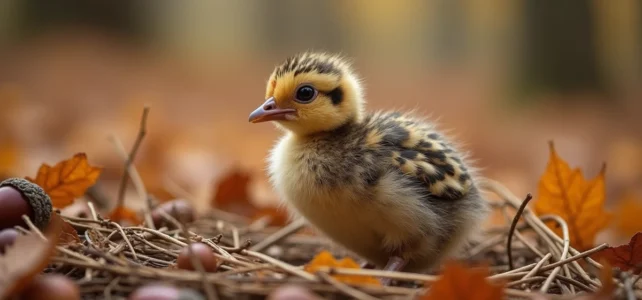
The pheasant chick, the name given to the young of the common pheasant (Phasianus colchicus), belongs to the category of precocial birds: it leaves the nest a few hours after hatching, capable of moving and foraging on its own. This characteristic shapes the entirety of its development and distinguishes its early days from those of most garden birds.
Crypsis of the pheasant chick: camouflage from birth
At hatching, the pheasant chick weighs very little and is barely the size of an adult thumb. Its body is covered in a brown-yellow down streaked with dark lines on the back and head. This color pattern, known as cryptic, mimics the dry grasses and forest litter where the hen pheasant nests on the ground.
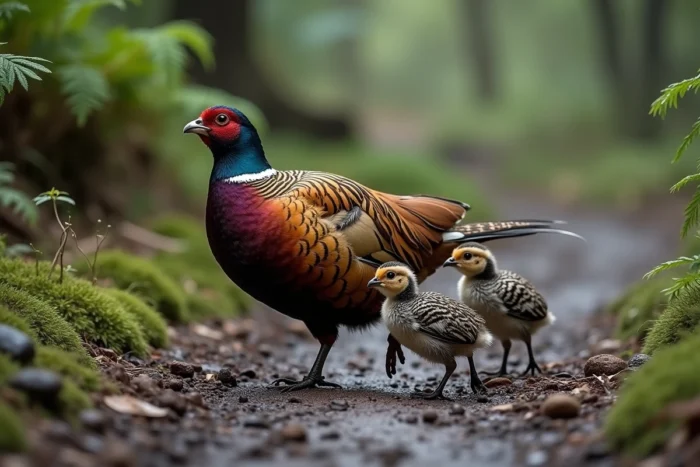
Contrary to what the spectacular plumage of the adult male suggests, the pheasant chick remains dull for several weeks. Both sexes are identical at this stage. No sexual dimorphism is visible until the first contour feathers replace the down, which occurs gradually starting from the second week.
To identify a baby pheasant with Boule de Poil, three combined clues must be observed: the characteristic dorsal stripes, the proportionally long legs relative to the body, and the short beak, finer than that of a chick.
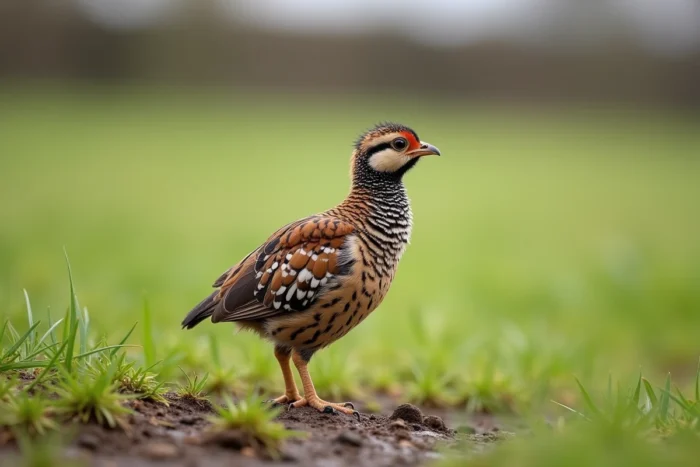
The most common confusion is with the young of the gray partridge. The pheasant chick can be distinguished by its longer tarsi, more elongated silhouette, and down that leans more towards yellow than the gray-olive of the partridge.
Diet of the young pheasant: from all-insect to mixed diet
The diet of the pheasant chick follows a clear transition. During the first two weeks, animal proteins make up almost all of its diet. Ants, small beetles, larvae, and spiders provide the necessary protein for the growth of feathers and skeleton.
Without sufficient access to invertebrates, the mortality of pheasant chicks increases significantly. This is why areas of grassy cover rich in insects play a direct role in the survival of broods in the wild.
From the third week onward, the diet gradually becomes mixed:
- Tender seeds (grasses, knotweeds) supplement the intake of insects without completely replacing it
- Young plant shoots and small leaves are increasingly consumed
- Invertebrates remain actively sought after, but their proportion in the diet decreases over the weeks
In farming, this transition is reflected in a starter feed rich in protein, followed by a gradual shift to a cereal mix. Several breeders have adapted their protocols in recent years, enriching the brooder environment (low perches, materials to peck) to limit pecking, a common behavior when density is too high or the environment too poor.
Plumage of the pheasant chick by age: stages of juvenile molt
The transformation of down into adult plumage follows a precise schedule, useful for estimating the age of a young pheasant found in the wild.
First and second week
The primary flight feathers break through the down by around the fifth day. By the end of the second week, the pheasant chick can perform short flights of a few meters, sufficient to escape a terrestrial predator. The rest of the body still retains its down.
Third to sixth week
The contour feathers replace the down on the back, sides, and chest. The young pheasant then resembles a small dull version of the adult female. The rectrices (tail feathers) begin to grow but remain short.
After six weeks
The first signs of sexual dimorphism appear in males: coppery reflections on the chest and a slight elongation of the central rectrices. The male-female differentiation becomes visually reliable between eight and ten weeks.
Survival of wild pheasant chicks: factors of early mortality
The mortality of pheasant chicks in the wild is high, concentrated in the first three weeks. Several factors contribute to this.
- Terrestrial predation (foxes, mustelids, cats) is the primary cause of loss, especially while the young cannot fly
- Episodes of prolonged cold rain cause rapid hypothermia, as the down provides only minimal thermal insulation
- Agricultural operations (mowing, harvesting) destroy nests and broods every year during the breeding season, between May and July
Hunting federations regularly report nest destruction during spring mowing. The hen pheasant, very attached to her nest, often only flees at the last moment, which exposes both the adult and the eggs or newly hatched chicks.
The influence of health context also weighs on the rearing of young pheasants. Since autumn 2025, outbreaks of avian influenza have led to mandatory confinement periods for poultry and game in several French regions, altering the conditions for releasing young in outdoor aviaries and imposing collective health management plans on breeders.
Recognizing a pheasant chick found on the ground: the right reflexes
A pheasant chick alone on the ground is not necessarily abandoned. The hen sometimes moves away to feed, and the young disperse into low vegetation in case of threat, remaining motionless thanks to their camouflage.
Before any intervention, observing from a distance for about twenty minutes allows checking if the mother returns. Handling a healthy pheasant chick only stresses it and separates it from its brood.
If the young bird shows signs of injury or remains prostrate for more than an hour without the hen reappearing, contacting a wildlife rehabilitation center remains the best option. Pheasant chicks require a high ambient temperature, a specific diet rich in animal proteins, and suitable space, conditions that are difficult to replicate without equipment.
The pheasant chick goes through its developmental stages in just a few weeks, from cryptic down to plumage that finally reveals its sex. This rapidity reflects a calibrated survival strategy: the faster the young can fly and feed itself, the greater its chances against predators and climatic hazards.