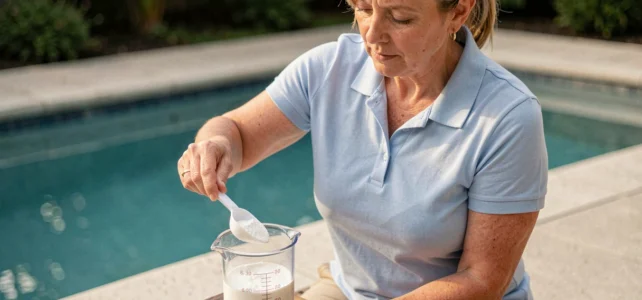
Sodium percarbonate is a compound that, when in contact with water, decomposes into sodium carbonate and hydrogen peroxide. This reaction releases active oxygen, making it primarily a powerful oxidant. In the pool industry, it is often presented as a versatile product capable of raising pH, but this claim deserves serious qualification.
Sodium percarbonate and pool pH: a misunderstanding to clarify
The confusion arises from the chemistry of the product. When percarbonate dissolves, the resulting sodium carbonate fraction is alkaline. It does indeed raise the water’s pH. The problem is that percarbonate is not designed as a pH corrector for recreational pools.
Technical data sheets from manufacturers specializing in pool treatment systematically classify percarbonate among algaecides, antibacterials, and anti-sludge products. For pH correction, the references remain pure sodium carbonate (sold under the name “pH+”) and sodium bicarbonate, each serving a distinct role.
Using percarbonate primarily to raise pH is akin to choosing an unsuitable tool. The effect on pH exists, but it is indirect, unpredictable, and difficult to dose accurately. To master the dosage of sodium percarbonate for pools, one must first understand that its primary action is oxidative, not regulatory.
Sodium carbonate, sodium bicarbonate, and percarbonate: the differences for your pool
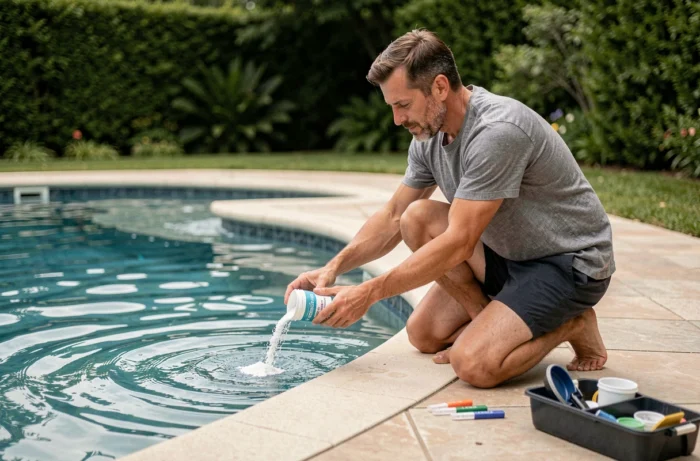
These three sodium-based products are often confused. However, their effects on pool water are very different, and interchanging them carelessly disrupts treatment.
- The sodium carbonate (soda, pH+) is the standard product for quickly and significantly raising a low pH. It acts directly on pH without adding active oxygen.
- The sodium bicarbonate is a weak base that gradually raises pH. It primarily affects alkalinity (TAC), the buffering parameter that stabilizes pH over time. When TAC is too low, pH fluctuates constantly.
- Sodium percarbonate releases both carbonate (alkaline effect) and hydrogen peroxide (oxidative effect). The active oxygen destroys algae and organic matter, while the carbonate fraction pushes pH up, but in a less controllable manner than pure pH+.
The key point is this: percarbonate combines two effects that we do not always want to activate simultaneously. If pH is low but the water shows no algae or cloudiness, adding percarbonate amounts to over-oxidizing water that does not need it, while also raising pH in an approximate manner.
TAC and pH: why correct in the right order before any dosing
Before adding any product to the pool, two measurements are necessary: pH and TAC (total alkalinity). Correcting pH without knowing TAC is the main cause of recurring imbalances.
TAC represents the water’s ability to resist pH fluctuations. A TAC that is too low means that pH will be unstable, regardless of the amount of corrector added. It will temporarily rise, then drop again within a few hours.
The logical protocol proceeds as follows:
- Measure pH and TAC with test strips or an electronic tester, at least once a week during the season.
- If TAC is insufficient, raise it first with sodium bicarbonate, which stabilizes alkalinity without causing a sharp pH spike.
- If TAC is correct but pH remains low, use sodium carbonate (pH+) for targeted raising.
- Only resort to percarbonate if the water presents a combined problem: low pH and the presence of algae, biofilm, or organic turbidity.
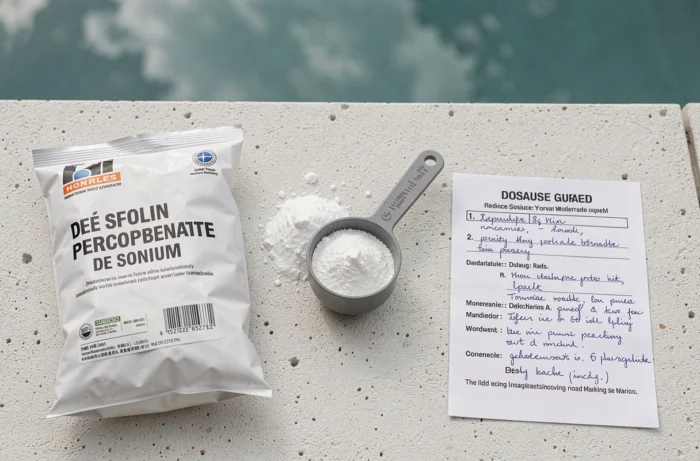
This sequence avoids the classic trap of repeatedly adding products without ever achieving a stable pH.
Sodium percarbonate in pools: when to really use it
Percarbonate has its place in pool maintenance, but not as a daily pH regulator. Its benefit lies in situations where the water needs an oxidizing treatment combined with a slight increase in alkalinity.
The water is green or cloudy after a storm, with a pH that has dropped below the target zone. Percarbonate then allows for a shock treatment: active oxygen attacks algae while the carbonate partially raises pH. This is a recovery treatment, not a fine-tuning tool.
In aquaponics, some users apply percarbonate at a rate of a few dozen grams per cubic meter of water as a weekly preventive treatment. This context is very different from that of a recreational pool, where the water volume, filtration system, and presence of chlorine completely change the equation.
For the regular treatment of a pool, percarbonate does not replace either pH+ or sodium bicarbonate. Combining it with chlorine in the same addition is not recommended: the hydrogen peroxide released by percarbonate reacts with chlorine and reduces its disinfecting power.
Dosage of percarbonate and precautions for pool water
The dosage of percarbonate varies according to the pool’s volume and the desired objective. The manufacturer’s instructions remain the reference, as the product concentration differs from one brand to another. A few principles remain constant.
Never pour the entire dose all at once. Splitting the addition allows for measuring the effect on pH after each addition and avoiding an overdose that would raise pH well beyond the target zone. Filtration should run during the operation to homogenize the dissolution.
After each addition, wait several hours before retesting pH. Percarbonate takes time to fully decompose, and the immediate measurement does not reflect the final state of the water. A new test the following morning provides a more reliable reading.
Percarbonate should be stored dry, protected from moisture and heat. Upon contact with water, the reaction starts immediately: an opened and poorly resealed bag gradually loses its effectiveness.
The safest approach to balance your pool’s pH remains to separate the functions: a dedicated pH corrector (sodium carbonate or bicarbonate depending on the case) for chemical balance, and percarbonate reserved for occasional oxidizing treatments when the water requires it.