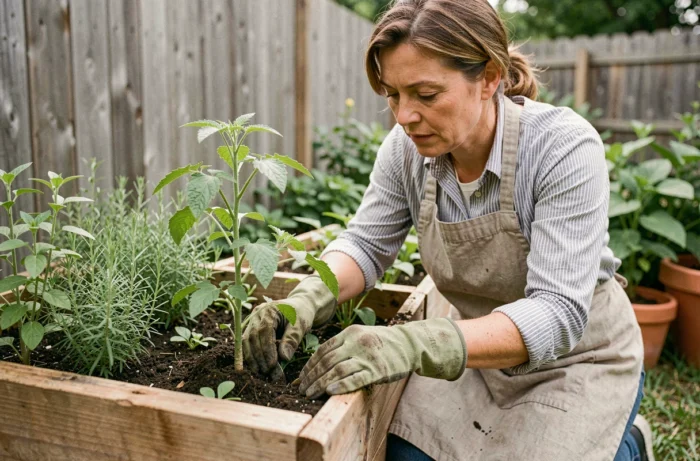
A garden that keeps its promises twelve months a year is first conceived through the soil, not through the plant catalog. Designing and maintaining a garden year-round requires thinking in terms of constraints (water, regulations, nature of the land) before thinking in terms of desires. We observe that most costly mistakes arise from a mismatch between the plant project and the actual conditions of the land.
Soil structure and drainage: the invisible foundation of any garden layout
Before any planting, a percolation test on the top thirty centimeters of the land provides more reliable information than any visual analysis. A compact clay soil will retain water in winter and crack in summer, which dooms most perennials with shallow roots.
We recommend conducting a simplified soil profile: dig a hole forty centimeters deep, water it, and observe the drainage time. If the water stagnates for more than two hours, drainage through trenches or gravel drains becomes a priority, well before choosing furniture or flowers.
Deep soil work (decompacting with a grelinette, adding shredded organic matter) is ideally done in autumn. Intervening in spring on soil still saturated with water destroys the structure and creates plow pans that will block the rooting of trees and shrubs for several years. Many resources on outdoor landscaping are gathered on the Maison, Jardin … & Services website, which also addresses earthworks and land preparation services.
Water restrictions and garden design: a regulatory constraint to integrate from the planning stage
The prefectural orders of 2026 have prohibited the watering of ornamental gardens between 8 AM and 8 PM in many departments, including for withdrawals from rivers or aquifers. The fine for non-compliance reaches 1,500 euros for a 5th class offense, and 3,000 euros in case of repeat offenses.
This regulation requires a clear distinction, from the design stage of the layout plan, between food-producing areas (vegetable garden, fruit trees) and ornamental areas (beds, lawn). The former often benefit from a more flexible regime, while the latter are the first to be affected by restrictions.
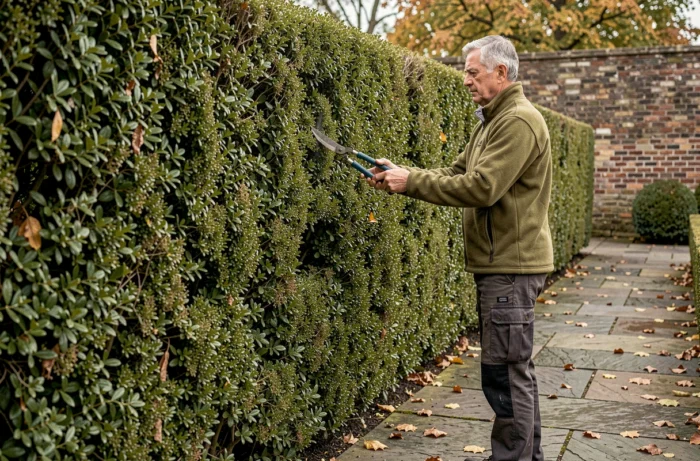
The direct technical consequence: the ornamental garden must be designed to survive without daytime watering. This involves three combined levers.
- Thick mulching (wood chips, miscanthus straw, shells) to a sufficient depth to significantly limit evaporation. A mulch that is too thin, just a few centimeters, will blow away or decompose in a few weeks.
- The choice of deep-rooted perennials and Mediterranean grasses (fescues, stipas, hardy pennisetums) that tolerate prolonged periods without water.
- The installation of a programmable drip irrigation system on a nighttime schedule, with a moisture sensor to avoid unnecessary cycles. A simple mechanical timer is no longer sufficient: a system capable of adapting to current regulations is needed.
Plant palette for a pesticide-free flowering garden all year round
The Labbé law prohibits the use of synthetic pesticides for individuals in gardens. This constraint, often mentioned but rarely translated into concrete plant choices, changes the logic of plant selection.
Old varieties of roses, often praised for their fragrance, are also among the most sensitive to powdery mildew and rust. Favor disease-resistant cultivars, identifiable by their ADR label (Allgemeine Deutsche Rosenneuheitenprüfung), a testing protocol without chemical treatment over several years.
To maintain visual interest throughout the four seasons, we structure the palette into three layers.
- Lower layer (ground covers and perennials): perennial geraniums, heucheras, epimediums. Flowering spread from spring to autumn, with evergreen or semi-evergreen foliage in winter.
- Middle layer (shrubs): colored-stemmed dogwoods for winter, panicle hydrangeas for summer, winter viburnums for January-February flowering.
- Upper layer (small-growing trees): Japanese maples for autumn color, serviceberries for spring flowering and fruit, birches with decorative bark for winter structure.
This layering ensures that no season leaves the garden empty. The vegetable garden completes the picture: green manures (mustard, phacelia) sown in autumn cover bare soil, nourish beneficial wildlife, and fix atmospheric nitrogen.
Seasonal garden maintenance: the realistic intervention calendar
Classic gardening calendars list dozens of tasks per month. In practice, five well-timed interventions are worth more than twenty scattered actions.
At the end of winter (February-March), the priority action is cleaning the grasses: they should be cut back before regrowth, not after. Pruning too late forces the plant to restart from already sap-filled wood, which weakens the clump.
In spring, organic fertilization focuses on summer-flowering shrubs and the vegetable garden. Feeding a spring-flowering shrub in April is pointless: its buds have already formed since the previous autumn.
In summer, high mowing of the lawn (minimum seven centimeters) reduces water stress much more effectively than additional watering. A closely mowed lawn during a drought yellows in a few days and takes weeks to recover.
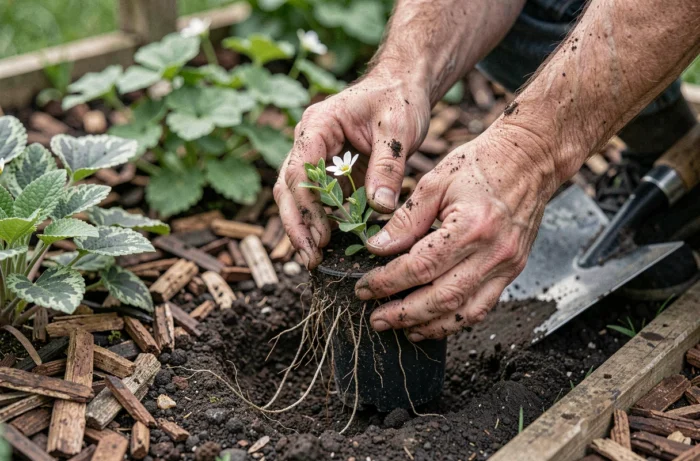
Autumn concentrates on planting trees, shrubs, and perennials. The still-warm soil promotes rooting before winter, and autumn rains ensure natural watering. Planting in spring requires watering throughout the summer, which directly conflicts with summer water restrictions.
Winter remains the season for pruning deciduous trees and structural assessment: checking fences, treating wooden decks before frost, storing garden furniture. These tasks condition the quality of spring restart as much as horticultural actions.


