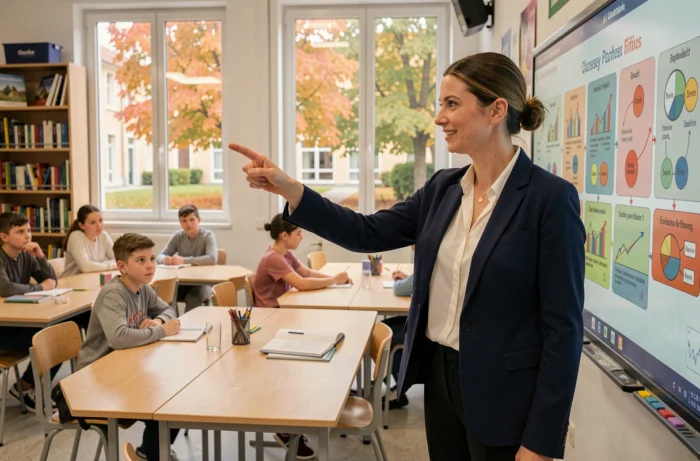
When a fifth-grade teacher discovers at the start of the school year that their class has decreased from 24 to 19 students, the decline reflects a heavy demographic trend that is reshaping the school map, programs, and educational tools across France. Several simultaneous projects are transforming the daily life of schools, families, and educational staff, sometimes quietly.
Demographic decline and school map over five years: what is changing concretely
The Ministry of National Education anticipates a decrease of about 1.7 million students between 2025 and 2035, representing a drop of approximately 14 to 15% in enrollment. This decline does not affect the territory uniformly: rural areas and small municipalities are losing classes much faster than metropolitan areas.
Since 2012, more than 5,000 schools have closed in France, including about 400 since 2024. Nearly 8% of schools now have only one class. For a parent in a rural area, the question is no longer “Will my child have a good teacher?” but “Will there still be a school nearby in three years?”
In light of this reality, a five-year school map replaces annual planning. The experiment, launched in 2026 in 18 pilot departments, integrates demographics, transportation, educational offerings, and the condition of school buildings. A national contractualization is planned starting in 2027. This topic is closely monitored on echosdecole.fr, which regularly relays academic decisions and their local consequences.
This change in method has a direct effect on municipalities: instead of fighting every spring against a class closure announced in February, elected officials now have multi-year visibility. Feedback on this point varies, with some local authorities believing that the five-year projection rigidifies decisions as much as it anticipates them.
Artificial intelligence in schools: curricula and teacher training
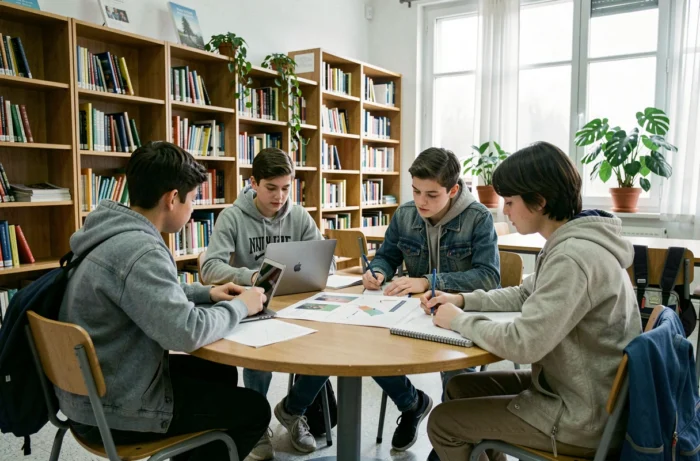
AI is no longer confined to conversations in the teachers’ lounge about ChatGPT. The Ministry of National Education has launched an explicit strategy for integrating artificial intelligence into school curricula, with a planned ramp-up until 2027.
Concretely, this translates into two simultaneous axes:
- The introduction of dedicated AI modules in the curricula, so that students understand how a language model works, what it produces, and what it does not guarantee
- Training for teachers on how to use these tools in their teaching practice, from diagnosing reading difficulties to differentiating exercises
- An ethical framework on the use of student data, a sensitive point for parents and associations
The goal is not to replace the teacher but to provide them with a lever for personalization that they did not have with a class of 25 different profiles. A mathematics teacher in a priority education network can identify in a few minutes the students struggling with fractions and offer them a tailored path while the rest of the group progresses.
The deployment remains uneven. Schools well-equipped with IT resources advance faster than those that still share a cart of tablets among four classes.
School year 2026: vocabulary in kindergarten, Latin in middle school, and mobile phone regulation in high school
Several measures that came into effect at the start of the 2026 school year are changing the school day in very tangible ways.
2,500 words by the end of kindergarten
The ministry has set a target of 2,500 words mastered by the end of kindergarten. For teaching teams, this means a daily time dedicated to structured vocabulary, with target word lists by level. Kindergarten teachers now incorporate short and repeated sessions, modeled on what cognitive science research has recommended for years.
Latin accessible from the fifth grade
Latin is returning to the ancient languages offered in middle school with easier access starting in the fifth grade. The idea is to no longer reserve this option for city center schools with a full-time classical literature teacher. In practice, collaborations between middle schools and video conferencing classes supplement the offering where the pool of teachers is lacking.
Mobile phone regulation in high school
After the ban in middle schools, the issue of mobile phones is extending to high schools. The ministry has announced a stricter framework, without a total ban, which leaves schools some leeway on the modalities. Some high schools are experimenting with phone lockers at the entrance, while others are content with a ban in class.
PISA 2025 results and social inequalities: where does France stand
The PISA 2025 results confirm a trend observed across all OECD countries: a decline in academic performance that is not unique to France. The ministry speaks of a “continuing need for improvement,” which amounts to acknowledging that successive plans have not yet reversed the trend.
The most concerning angle remains that of social inequalities. The performance gap between students from privileged backgrounds and those from disadvantaged backgrounds is more pronounced in France than in the OECD average. This observation is not new, but it persists despite the measures for smaller class sizes in priority education networks implemented in recent years.
The Montaigne Institute estimates that France needs a comprehensive educational strategy, not successive adjustments. This reflects a recurring criticism: the “dance of reforms” has produced, over twenty-five years, hundreds of modifications to the education code without overall coherence.
For families, this data translates into a simple question: does the public school in the neighborhood offer the same chances as a private school in the city center? The answer still largely depends on the postal code, which fuels avoidance strategies and reinforces the phenomenon that rankings were supposed to combat.
The educational news in the coming months will revolve around the implementation of these projects. The multi-year school map, the integration of AI, and the adjustments post-PISA are not isolated announcements. Their real effect will depend on what happens in classrooms on a daily basis, not on the timing of ministerial press releases.