
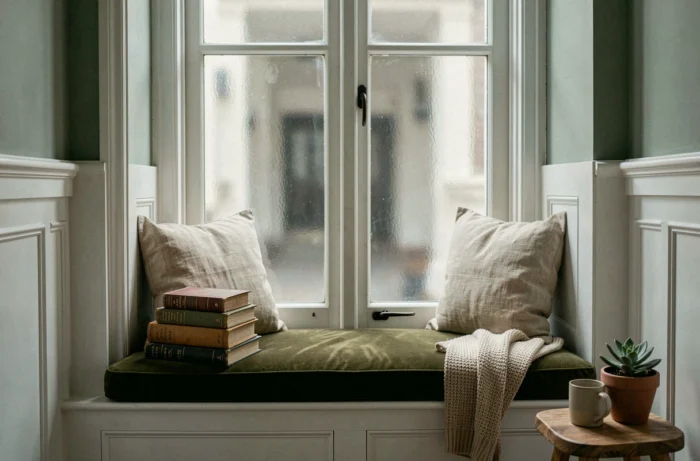
Transforming a house into a cocoon is not just about choosing a throw or a scented candle. The issue touches on more structural questions: air quality, management of natural light, adapting spaces to the actual uses of daily life. Since remote work has become a permanent fixture in French households, the way we inhabit our interiors has changed, and expectations regarding domestic comfort have become clearer.
Summer comfort and insulation: the regulatory framework that changes the game
Before choosing colors or cushions, you need to ensure that the housing itself is not working against you. In France, summer comfort is now integrated into the official definition of high-performance energy renovation. No longer suffering from heat at home is no longer a subjective luxury; it is a regulatory objective.
Since 2025, condominiums over fifteen years old must establish multi-year work plans in which this criterion is explicitly included. This influences insulation, solar protection, and ventilation of homes. If you are a homeowner, checking the condition of these aspects before any decoration has a much more lasting impact on the feeling of cocooning than a change of curtains.
Thermal insulation also affects acoustic comfort. A room where the temperature remains stable and where external noises are reduced naturally creates a feeling of enveloping, without any decorative artifice.

Indoor air quality: an underestimated lever for well-being at home
You can explore the home universe on Monsieur Bricoleur for layout ideas, but the first reflex should concern what we breathe. Indoor air is often more polluted than outdoor air, due to volatile organic compounds (VOCs) emitted by furniture, paints, cleaning products, and certain textiles.
A properly maintained mechanical ventilation system remains the most reliable way to renew the air without opening windows in the middle of winter. Field reports vary on the effectiveness of portable air purifiers: their usefulness depends on the room size, type of filter, and frequency of replacement.
Materials and coatings to watch
The choice of interior decoration materials has a direct effect on air quality. Low-VOC paints carry specific labeling (class A+). Particle board furniture, very common, releases formaldehyde for several months after purchase.
- Favor A+ rated paints and water-based finishes to limit emissions in enclosed spaces
- Air out new reconstituted wood furniture in a garage or ventilated room for a few weeks before installing it in a bedroom
- Avoid scented candles with incomplete combustion, which release fine particles, and prefer flame-free diffusers
Natural light and artificial lighting: adapting each room to its use
Light is probably the factor that most alters the perception of a space. An identical room appears cold or warm depending on the color temperature of its light sources.
A warm temperature lamp (around 2,700 kelvins) in a living room creates an immediate cocooning effect. Conversely, cool lighting is better suited for a workspace. Mixing the two in the same room creates a confusing atmosphere.
Increase natural light without overheating
Clearing the area around windows, using mirrors to reflect light into dark areas, choosing sheer curtains instead of opaque ones: these simple adjustments change the perception of a bedroom or living room. However, in south-facing rooms, external solar protections (blinds, awnings) are more effective than interior curtains for maintaining a pleasant temperature.
Home office space: separating functions to preserve the cocoon
Chosen remote work generally comes with a better sense of physical and mental health, provided that employees have a suitable home environment: ergonomics of the workstation, separation of spaces, good quality light.
Setting up your desk in the bedroom or living room blurs the boundary between rest and activity. The brain then associates the room with work, which degrades the quality of relaxation and sleep. Even in a small apartment, a movable partition, a screen, or a simple change in furniture orientation is enough to create a visual boundary.
Ergonomics and ambiance of the office corner
- Position the screen perpendicular to the window to avoid glare without losing natural light
- Choose an adjustable seat in height and seat depth, as poor posture negates all the comfort gained elsewhere
- Plan for adjustable task lighting for short days, distinct from the general lighting of the room
- Store work materials in a closed cabinet at the end of the day to visually disconnect from professional activity
A domestic cocoon is primarily based on technical foundations: proper insulation, healthy air, suitable light, spaces with clearly defined functions. Decoration choices (colors, textiles, cushions, atmosphere) only produce their full effect when these bases are in place.


