The market for ethnic decorative objects is no longer limited to bringing back a mask or a woven basket from a distant trip. Behind the appeal of raw materials and patterns from elsewhere, recent European regulatory constraints are reshaping what can be legally imported, sold, and displayed at home. Understanding these new rules allows for the selection of pieces that are both original and traceable.
European Regulation on Deforestation: What Changes for Exotic Wood Furniture
The European regulation on deforestation (EUDR) requires importers and manufacturers to submit a due diligence declaration in a dedicated information system. This declaration must document the geolocation of the harvesting plots, the legality of the cutting, and the traceability of the wood to the finished product.
For large and medium-sized enterprises, the EUDR will apply starting December 30, 2026. Micro and small enterprises have an additional deadline, with enforcement set for June 30, 2027. In practice, a carved teak piece of furniture or a root wood console sold in the European Union will need to prove that it does not contribute to deforestation.
The catalog offered on bazaaretcompagnie.com illustrates the diversity of available ethnic decorative objects, from wooden pieces to artisanal textiles. In light of this regulation, buyers benefit from checking whether the seller mentions the precise geographical origin of the wood used.
Forced Labor and Imported Craftsmanship: A Second Regulatory Filter
Regulation (EU) 2024/3015 targets products made from forced labor. It prohibits the import and marketing within the EU of any product whose manufacturing involves forced labor, including items from third countries.
Ethnic handcrafted objects are directly affected by this regulation. Hand-carved figurines, weavings, baskets: the production chain of these pieces often escapes traditional industrial circuits, making verification more complex.

Field reports vary on the actual capacity of small importers to document their supply chains. Large brands have structured compliance services, but an artisan bringing back a few pieces from a workshop in Benin or Cambodia faces traceability obligations designed for industrial flows.
Natural Materials and CITES Convention: What Customs Can Block
Ethnic decoration relies on materials like wood, rattan, horn, bone, or certain plant fibers. Several of these materials fall under the CITES convention, which regulates international trade in endangered species.
- Ivory, even antique, is subject to strict restrictions. A decorative object containing ivory requires proof of antiquity and export certificates compliant with current regulations.
- Some skins, feathers, or shells used in African or South American craftsmanship are prohibited from import without CITES documentation, even in decorative quantities.
An object confiscated by customs is not eligible for a refund. Before purchasing an item made from animal material or rare wood species while traveling, checking the CITES status of the species avoids an unpleasant surprise upon return.
Authenticating the Origin of an Ethnic Decorative Object: Concrete Criteria
The appeal of ethnic objects lies in their artisanal character and cultural roots. However, the market is flooded with industrial copies made on a large scale, often in China, and then labeled with vague geographical mentions.
Several clues can help distinguish a handcrafted piece from a reproduction:
- Surface, color, or shape irregularities indicate manual work. A perfectly symmetrical and uniform object has likely been molded.
- Documented provenance (name of the workshop, manufacturing region, identified raw material) serves as a more reliable traceability marker than a simple “handmade” mention.
- Craftsmanship labels recognized by exporting countries provide additional assurance regarding production conditions.
A transparent reseller publishes the geographical origin and the name of the artisan. This information, absent from most online product listings, remains the most discriminating criterion for assessing the authenticity of a piece.

Integrating Ethnic Objects into an Interior Without a Cluttered Effect
The available data does not allow for a universal dosage rule, but successful approaches share one principle: limit the number of strong ethnic pieces per space. One or two statement pieces (a large wall textile, a sculpted console) are enough to set the tone of a living room.
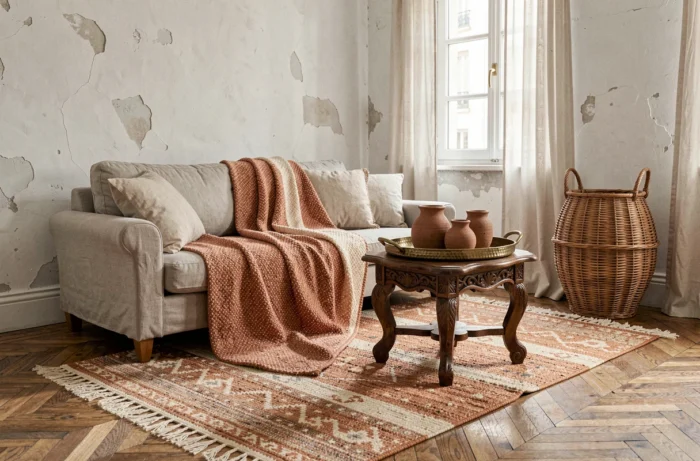
The rest of the furniture benefits from remaining understated. A neutral linen sofa, a polished concrete floor, or a white wall creates a backdrop that highlights a Berber rug or a terracotta pottery without visual overload. Natural materials like rattan, jute, or bamboo serve as a link between the ethnic object and contemporary decor.
The ethnic chic ambiance relies less on the quantity of objects than on their presentation. An African mask placed on a minimalist shelf creates more impact than an accumulation of figurines on a display cabinet. The bohemian style, often associated with ethnic decor, works through layering textures (kilim cushions, raw wool throw) rather than multiplying geographical references.
The ongoing European regulatory framework will gradually transform the available offer of ethnic decorative objects. Traceable, documented pieces from transparent supply chains will increase in value, while opaque imports will become riskier. Choosing an object with known origins secures the purchase and contributes to the sustainability of artisanal know-how.


