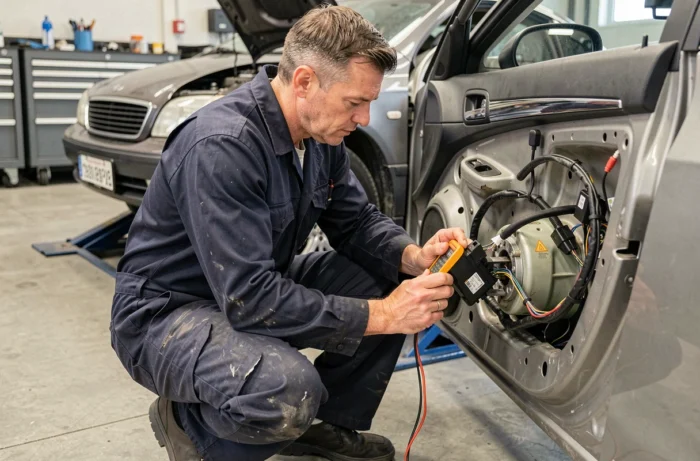
You press the remote control, all the doors lock except one. Or worse, none respond. A faulty central locking system turns a simple action into a daily source of frustration. Before dismantling anything, the right reflex is to reason by elimination, from the simplest to the most complex.
12 V Battery and Central Locking: The Invisible Breakdown
Most tutorials point directly to the lock actuator or wiring. They overlook a common and underestimated cause: the 12 V battery nearing the end of its life.
A vehicle with a weakening battery does not abruptly stop starting. It begins with secondary symptoms: erratic locking, remote control that works every other day, trunk that no longer responds. According to ADAC data 2025-2026, the 12 V battery is the leading cause of breakdowns across all types of engines, accounting for 45.4% of cases.
This observation also applies to recent electric vehicles, which still carry a 12 V battery to power accessories and locking. Before ordering an actuator or removing a door panel, test the voltage of your battery with a multimeter. A value below 12.4 V with the engine off indicates a tired battery.
To deepen the diagnosis on locking mechanisms, the Serrurier Dic troubleshooting guide details additional checks step by step.
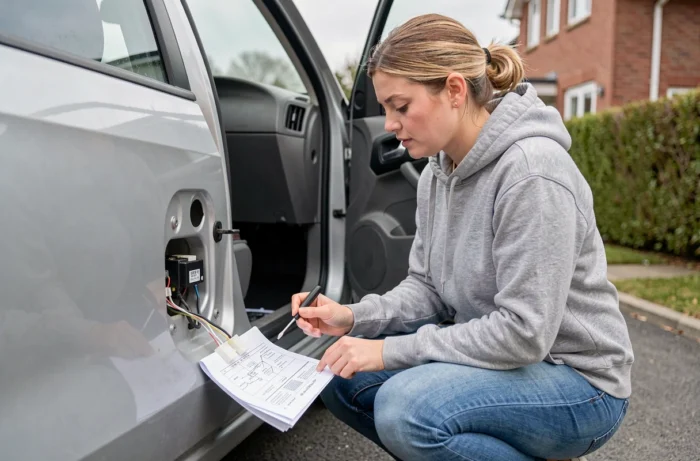
Symptom Diagnosis: Identifying the Locking Failure
A central locking system involves several components. The symptom you observe directly points to the faulty part.
The remote control triggers nothing
Start with the most obvious: the remote control battery. Replace it before any other test. If the problem persists, try locking from the interior button of the vehicle or with the mechanical key in the driver’s lock.
When the physical key works but the remote does not, the issue lies with the radio receiver or pairing. A desynchronization can occur after a vehicle battery change. The reprogramming procedure varies by manufacturer, but it is usually found in the maintenance booklet.
Only one door refuses to lock
If all doors respond except one, the actuator for that door is likely defective. The actuator (also called the lock motor) is a small electric motor housed in the door. When it fails, you may sometimes hear a clicking or buzzing sound without the lock moving.
To confirm, listen to the suspect door when you activate the central locking. A mechanical noise without movement of the latch indicates a seized or broken actuator. A complete absence of noise points more towards a wiring or connector issue.
The doors unlock by themselves
This worrying symptom often relates to a fault in the body control module (the electronic box that manages the locking). Software or module failures are now among the top five causes of service calls, according to a Carwow analysis from September 2026. On recent vehicles, a simple bug in the module can simulate a mechanical failure.
DIY Repair of a Faulty Lock Actuator
You have isolated the problem to an actuator. The good news: this repair is accessible with common tools.
Here are the concrete steps:
- Disconnect the 12 V battery to work safely on the door’s electrical circuit.
- Remove the interior trim panel of the affected door (plastic clips, screws hidden behind decorative covers, window regulator connector to disconnect).
- Locate the actuator fixed to the lock mechanism, usually held by two or three screws and an electrical connector.
- Disconnect the connector, remove the screws, extract the actuator, and compare it with the new part before reassembling.
- Reassemble in reverse order, reconnect the battery, and test the locking from the remote and the interior button.
A replacement actuator typically costs a few dozen euros depending on the vehicle model. The repair takes between thirty minutes and an hour.
Wiring and Connectors: The Sneaky Failure in Doors
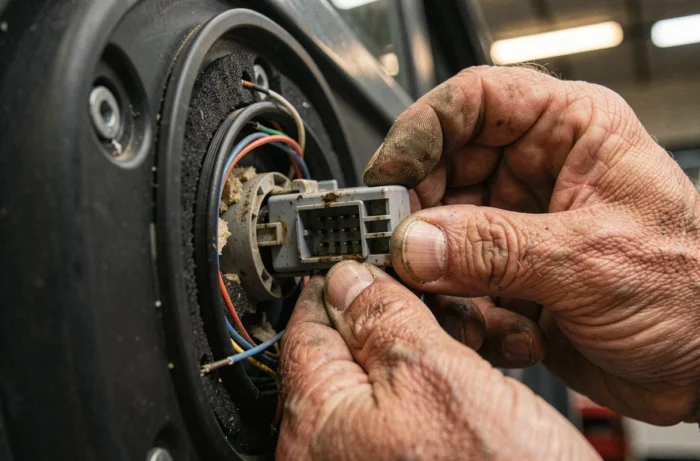
You have changed the actuator, but the problem persists? The wiring deserves careful inspection. The wires connecting the door to the body pass through a rubber boot at the hinge. This passage is the most frequent break point in the circuit.
With repeated openings and closings, the wires bend, wear out, and eventually break. Oxidation of the connectors exacerbates the problem, especially in humid or salty regions during winter.
Visually check the condition of the boot. If it is split or detached, water may have infiltrated. Gently pull on each wire at the door passage to detect a break. A broken wire can be easily re-soldered with heat shrink tubing to insulate the joint.
When to Call a Professional
Two situations justify a visit to the workshop:
- The body control module is involved (diagnosis impossible without an OBD scanner suitable for the manufacturer).
- Multiple doors malfunction simultaneously without connection to the battery, which may indicate a problem with the vehicle’s CAN network.
- The key or remote requires reprogramming that you cannot perform yourself (some manufacturers lock this procedure).
A diagnostic scan costs less than blindly replacing parts. If you have already ruled out the battery, remote battery, and actuator, visiting a specialist avoids unnecessary purchases.
The central locking system remains a generally reliable system, but its failures often combine electrical and mechanical issues. Reasoning from the simplest (battery, battery) to the most complex (module, CAN network) saves time and money with each intervention.


