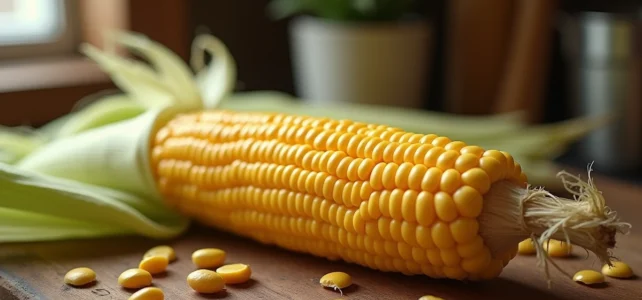
The cobette refers to a half-ear of sweet corn, cut crosswise to facilitate handling and cooking. The term comes from the English “cob” (the rachis, the central stem of the ear) to which the French diminutive suffix “-ette” has been added. We find this format in both fast food and on domestic barbecue tables, where it has established itself as a standalone side dish.
Cobette and cébette: a common confusion that changes the entire dish
The phonetic proximity between cobette and cébette causes recurring errors in online searches and even on some product sheets for fresh produce. The cébette is a young onion whose bulb has not developed, used like a scallion. There is no botanical or culinary link with corn.
Confusing the two leads to inconsistent search results and, in the worst case, to an inappropriate purchase. To eliminate any ambiguity, we recommend systematically associating the word “corn” with the query when searching for recipes or cooking tips related to the cobette.
With this distinction made, the definition and origin of the cobette indeed refers to an ear of sweet corn harvested at maturity, then cut into short portions. Corn itself is a grain native to Central America, cultivated for millennia by indigenous peoples before spreading to all continents.

Cooking the cobette on the grill and plancha: the high-temperature shift
The majority of guides limit themselves to three methods: boiling water, conventional oven, barbecue. We observe a clear trend towards express cooking at high temperatures on a plancha or grill, which is particularly well-suited to the cobette.
Young sweet corn contains a high proportion of simple sugars. Exposed to an intense heat source, it caramelizes on the surface while maintaining a tender and juicy core. The Maillard reaction then produces grilled aromas that boiling water cannot offer.
Parameters to master on the plancha
The plancha should be preheated to very high temperatures before placing the cobettes. A light film of sunflower oil (or grape seed oil, which is more neutral) is sufficient. Each side remains in contact with the surface for just a few minutes, enough time to achieve pronounced grill marks.
- Turn the cobette a quarter turn to grill all four sides evenly, without allowing one side to char
- Salt only at the end of cooking: salt applied too early extracts moisture and hinders caramelization
- Brush with flavored melted butter (garlic, Espelette pepper, chives) in the last thirty seconds, away from direct flame
This quick approach preserves the crunch better than the oven and gives a texture that is both melting on the inside and crispy on the surface.
Steam oven: the unknown alternative
The steam oven, increasingly common in equipped kitchens, offers a very different result. The cobette cooks in just a few minutes without fat, retains all its sugars, and maintains a bright yellow color. This is the method that best preserves the raw flavor of corn, ideal before a cold seasoning (tangy vinaigrette, furikake, lime juice).

Seasoning the cobette: moving beyond classic butter-salt
Salted butter remains the standard, but it is not a requirement. The cobette can support much more complex flavor profiles, provided the balance between fat, acid, and aromatic strength is respected.
- Brown butter and white miso: miso adds umami without masking the sweetness of the corn, while brown butter adds a roasted note
- Toasted sesame oil, soy sauce, and black sesame seeds: a classic pairing in Korean cuisine for grilled street corn
- Thick crème fraîche, powdered ancho chili, and grated hard cheese: a version inspired by Mexican elote, directly transposable to the cobette
- Lime juice, fresh cilantro, and chopped bird’s eye chili: a raw finish to be added just before serving, for a sharp thermal contrast
Each of these mixtures should be dosed according to the chosen cooking method. A cobette grilled on the plancha, already rich in Maillard aromas, requires a more discreet seasoning than a cobette taken out of the steam oven.
Cobette served as a side dish: pairings and menu logic
The cobette works better as a side dish than as a garnish lost in a composite plate. Its shape encourages direct handling, which directs the service towards a casual format.
Paired with grilled meats (pork ribs, marinated chicken, flank steak), it plays the role of a sweet and crunchy counterpoint. Next to fish, we recommend prioritizing steam cooking and an acidic seasoning to avoid overpowering the marine flavors.
The cobette is eaten warm, not hot. Letting it rest for two minutes after cooking allows the sugars to stabilize and the butter to be absorbed by the kernels rather than running off onto the plate. This detail changes the tasting experience.
One last point that mainstream recipes overlook: preservation. A fresh ear of corn loses its sugars quickly after harvest. If you buy pre-cut cobettes wrapped in film, check that the kernels are plump, shiny, and free from brown spots. A dull and dry kernel signals corn that has been harvested too long ago, which will yield a floury cobette regardless of the cooking method.