
The size of a cap is not just a number printed on the label. The head circumference provides a baseline, but the actual comfort also depends on the depth of the crown, the fabric material, and the closure system. Understanding these parameters helps avoid returns and headaches after an hour of wear.
Crown Depth and Skull Shape: Criteria That Head Circumference Doesn’t Capture
The head circumference, measured in centimeters with a flexible measuring tape, remains the starting point. It is taken about two centimeters above the eyebrows, going around the back of the ears.
This measurement says nothing about the height of the skull. Two people with the same head circumference can have very different skull shapes: one with a rather round and high skull, or another with a flatter and more oval skull. A cap whose crown depth does not match this morphology will press on the top of the skull or, conversely, float without support.
The crown refers to the part of the cap that covers the top of the head. Structured crown models (reinforced with a fusible interfacing) maintain their shape even when not worn. They are suitable for rather round skulls. Soft crowns, known as “unstructured,” fit flatter or oval heads better because they adapt without resistance.
Before finalizing a size, it is therefore useful to consult a cap size guide that details these distinctions, rather than relying solely on the circumference.
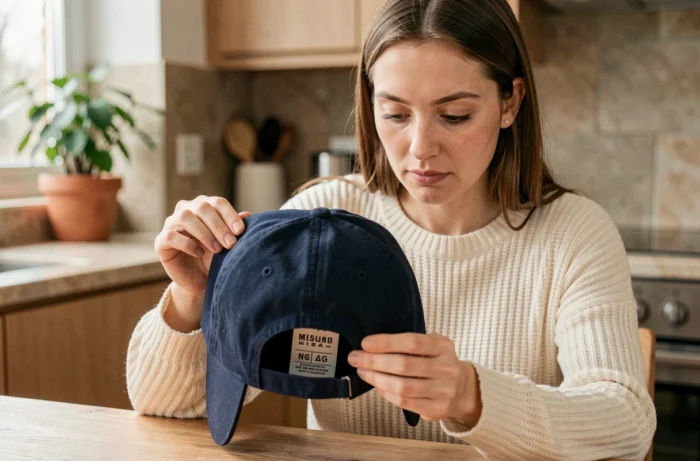
Fabric Material and Cap Size: Why Textile Changes the Game
A thick unwashed cotton may shrink after a few washes. In this case, taking a margin of half a centimeter to one centimeter above the actual measurement protects against a cap that becomes too tight within a few weeks.
Conversely, a stretch fabric (polyester-elastane blend, for example) tolerates a more exact measurement, even slightly lower. The elasticity compensates for the difference, and the fit remains firm without compressing.
- Raw cotton or untreated wool: plan for a size up if the cap has not been pre-washed in the factory, as shrinkage during washing is significant.
- Polyester or nylon: stable materials that hardly change during washing. The exact head circumference measurement is sufficient.
- Stretch blends (cotton-elastane, polyester-spandex): the exact measurement works, or even half a centimeter below for a snug fit around the skull.
The choice of fabric alters the size recommendation, even with the same circumference. Ignoring this parameter is the primary source of disappointment upon receiving an online order.
Adjustment System: Fixed Size, Snapback, or Strapback
The rear closure system determines the flexibility available once the cap is purchased.
Fitted Cap (Fixed Size)
No adjustment system. The size is expressed in centimeters or fractions of an inch. The head circumference measurement must be accurate to the nearest centimeter, as no correction is possible after purchase. This format offers the best support for active movement, but it also allows the least room for measurement error.
Snapback and Strapback
The snapback uses a plastic snap band, while the strapback uses a strap (fabric, leather, metal). Both allow for adjusting the circumference over a range of several centimeters. They are suitable when hesitating between two sizes or when planning to wear the cap with different hairstyles (loose hair, bun, thin beanie underneath in winter).
The snapback offers adjustment in fixed increments, thus less precise. The strapback allows for continuous, finer adjustment. For head circumferences that fall between two standard sizes, the strapback is the most reliable format.

Reliable Measurement Method: Avoid Common Mistakes
The technique of using a flexible measuring tape is simple, but some common mistakes often distort the result.
- Measuring too low on the forehead: the tape goes down over the eyebrows instead of staying two centimeters above. The resulting circumference is larger than the actual contact area of the cap.
- Tightening the tape: the tape should lie flat against the skin without compressing. A head circumference taken too tightly underestimates the actual size.
- Measuring over a voluminous hairstyle: wet or slicked-back hair gives a lower measurement than the reality of daily wear. Measure with the usual hairstyle.
- Not rounding up to the next centimeter: if the result falls between two graduations, round up. Better to have half a centimeter of play than constant pressure on the forehead.
Without a measuring tape, a string and a flat ruler work. Wrap the string around, mark the crossing point with a pen, then measure the length flat. The accuracy is slightly lower, but sufficient for a purchase in adjustable size.
Letter Size and Centimeter Correspondence
Brands do not all use the same reference. An “M” from one manufacturer may cover a different range from another. The table below provides a common correspondence, but each brand publishes its own chart that should be checked before ordering.
| Letter Size | Indicative Head Circumference |
|---|---|
| S | 54-55 cm |
| M | 56-57 cm |
| L | 58-59 cm |
| XL | 60-61 cm |
These ranges vary by one to two units depending on the brands. The only reliable constant remains the measurement in centimeters, cross-referenced with the relevant manufacturer’s chart.
Choosing a cap by combining head circumference, crown depth, material, and type of adjustment significantly reduces the risk of unpleasant surprises. The size printed on the label is just a first filter, not a guarantee of comfort.