
A cruise control that no longer responds to the activation button usually points to a blown fuse. However, locating the correct fuse requires more than just a glance at the box under the dashboard, especially in recent vehicles where protection circuits are shared among several electronic functions.
Cruise Control Fuse and Shared ADAS Circuits: What Changes the Diagnosis
In vehicles produced before 2020, the cruise control fuse had an explicit marking: “Cruise Control,” “CC,” or “Speed Control.” A quick look at the fuse box cover was sufficient.
The recent trend is towards sharing fuses for ESC, ABS, cruise control, and ADAS. On the same circuit, a fuse now protects stability control, emergency braking assistance, and adaptive cruise control. The label on the manufacturer’s diagram may be “Transmission Stability Control” or a platform-specific abbreviation, without a direct mention of the cruise control.
The practical consequence is twofold. A blown fuse on this circuit simultaneously cuts off several driving aids, not just the cruise control. Conversely, if only the cruise control is not functioning while the ESP and ABS remain operational, the shared fuse is probably not the issue. We recommend checking this point before removing anything.
To understand where the cruise control fuse is located on a given model, the diagram in the owner’s manual remains the reliable source. The generic symbols visible on the fuse box cover no longer reflect the reality of shared circuits.
Unusual Fuse Box Locations by Vehicle Type
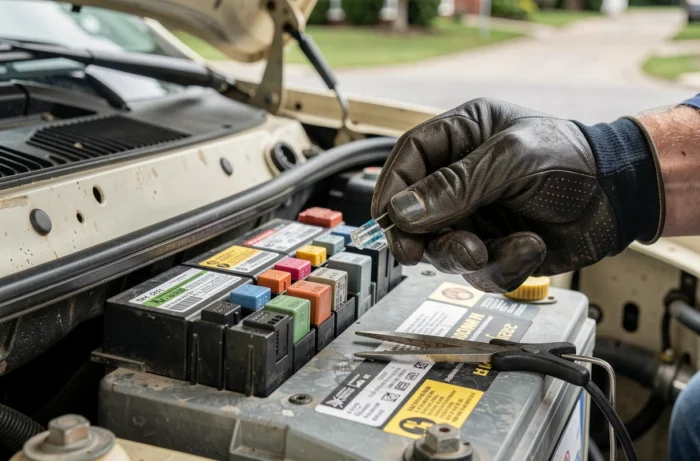
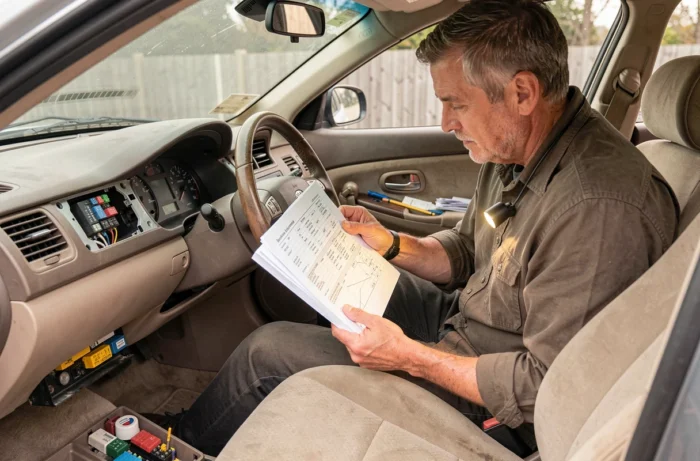
The cabin fuse box (under the steering wheel, driver’s side) and the engine compartment box are the two classic locations. Most articles stop there. In some utility vehicles and recent platforms, a third box exists.
- On the Mercedes-Benz Sprinter (2022-2024 generations), a main fuse block is relocated under the driver’s seat and protects the driving electronic modules, including the cruise control circuit.
- On several SUVs and sedans equipped with level 2 ADAS, a secondary fuse box is located in the trunk or behind a side panel of the luggage compartment.
- On some Asian vehicles (like the Mitsubishi Pajero), the cruise control fuse is housed in the engine box but referenced under a circuit number that does not appear on the cover: only the technical manual provides the correspondence.
Searching only in the two usual boxes wastes time when the fuse is located elsewhere. We regularly observe unnecessary workshop interventions because the technician did not consult the specific diagram for the model year.
Reading the Manufacturer’s Diagram
The owner’s manual provides a diagram with location number, amperage, and function. First, locate the “Cruise” or “ADAS” function in the alphabetical index rather than going through the diagram case by case. In digital manuals accessible via the manufacturer’s app, a keyword search speeds up the process.
Diagnosing the Cruise Control Fuse with a Multimeter
Visual inspection of the filament remains the quick method, but it is not reliable on opaque case fuses (Jcase or low cartridge type). The continuity test with a multimeter is the only conclusive check.
Set the multimeter to continuity mode (diode/buzzer symbol). Place one probe on each metal terminal of the fuse, without removing it from the holder at first if the terminals are accessible. A continuous beep confirms that the fuse is conducting. The absence of a signal indicates an internal break.
If the fuse appears intact but the cruise control still does not respond, measure the voltage upstream and downstream of the fuse, with the ignition on. A voltage present upstream but absent downstream, despite an apparently good fuse, indicates a bad contact on the fuse holder (oxidation, deformed tab). This fault is common in vehicles exposed to moisture or whose engine box is not perfectly sealed.
Special Case of Jcase and Low Cartridge Fuses
These formats, common on GM platforms, Stellantis, and some recent Korean models, do not allow any visual inspection of the filament. The colored case indicates the amperage, but the internal break remains invisible. The multimeter is therefore mandatory. We recommend keeping a spare set of Jcase fuses in the vehicle, as they are not available at all gas stations.
Replacing the Fuse and Post-Intervention Check
Ignition off, key removed. Use the extraction pliers provided in the fuse box cover (or needle-nose pliers) to remove the defective fuse. Replace it with a fuse of the same amperage and format, never with a higher rating: an oversized fuse removes protection and exposes the wiring to overheating risks.
After inserting the new fuse, turn on the ignition and activate the cruise control at a sufficient speed (generally above 40 km/h according to manufacturers). If the cruise control works, the diagnosis is complete.
If the new fuse blows immediately or within minutes, the problem lies downstream: short circuit in the wiring, fault in the control module, or brake switch. In this case, do not replace the fuse a third time. A fuse that blows repeatedly protects the circuit against a real fault that requires thorough diagnosis, ideally with a fault code reader tool (OBD-II).
Additional Checkpoints
- Check the brake pedal switch: a stuck switch in the “brake pressed” position disables the cruise control permanently, even if the fuse is good.
- Inspect the connectors of the steering wheel control module: a bad contact on the switch harness can mimic a fuse fault.
- On vehicles equipped with a radar or front camera, a dirty or misaligned sensor generates a fault code that inhibits adaptive cruise control unrelated to the fuse circuit.
A cruise control fuse that blows once is a one-time incident. A fuse that blows repeatedly indicates a wiring or component fault that no fuse replacement will resolve. Distinguishing between the two situations saves hours of unnecessary searching.