
Real estate developers are facing increasing pressure on their margins. Between the rising cost of materials, the requirements of RE2020, and the growing complexity of operations, controlling construction costs no longer relies solely on negotiating with contractors. It now requires the ability to manage each budget item in real-time, lot by lot, situation by situation. This is where real estate development software shows its concrete usefulness.
Project Overruns and Amendments: The Real Loss for Developers
Budget overruns on a project do not happen all at once. They accumulate in small layers: an unanticipated amendment here, a poorly monitored retention there, a validated work situation without cross-referencing with the projected budget.
According to documented feedback from Kolonell in 2026, a real-time project tracking module allows for a reduction of about 20% in budget overruns compared to the projected budget. This gain is based on tracking by lot and the systematic updating of work situations.
The main economic value of management software for developers does not lie in a decrease in gross construction costs. It is about controlling the margin through the reduction of overruns and oversights: unpaired situations, amendments signed without overall arbitration, retention forgotten during the lifting of reservations. These micro-losses, invisible one by one, erode the profitability of a project.
In this regard, the real estate development software from Interactif Immo precisely centralizes budget management and situation tracking to limit these overruns right from the construction phase.
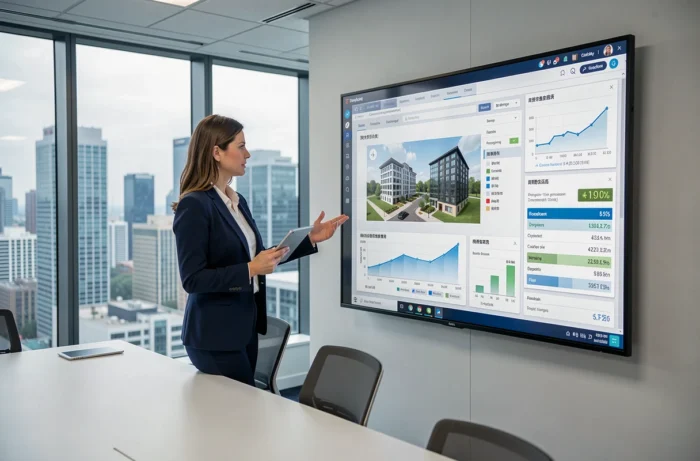
Real Estate Development Software and Real-Time Financial Tracking
A shared Excel spreadsheet among the program director, site manager, and accounting department mechanically generates contradictory versions. The financial data of a real estate project is dynamic: it evolves with each validated situation, each work order, each negotiation with a subcontractor.
A software dedicated to real estate developers structures this data around three axes:
- Budget consolidation by lot, which continuously reconciles the projected, committed, and invoiced amounts, without manual re-entry.
- Tracking of amendments with traceability of their impact on the overall margin of the project, before validation.
- Management of funding requests and payment schedules, synchronized with the actual progress of the construction site.
This real-time operation changes the nature of decisions. A program director who notices an overrun on the structural work lot in month three can immediately make decisions regarding the finishing work lots. Without a centralized tool, this information often arrives too late, sometimes at the project’s final assessment.
Scenario Simulation Before Commitment
Some software includes simulation modules that allow testing the financial impact of changing a service provider, using an alternative material, or shifting the schedule. This feature does not replace the expertise of the project manager, but it provides them with a quantified view of possible trade-offs before they become irreversible.
RE2020 and Material Cost Overruns: What Regulation Changes for Cost Management
The gradual milestones of RE2020 between 2025 and 2030 impose increasingly demanding thresholds on the carbon emissions of new buildings. Each level can render a previously approved material choice obsolete.
Field feedback varies on this point: some developers absorb the additional costs related to bio-sourced materials through savings in other areas, while others see a net increase in overall costs. The available data does not allow for a uniform conclusion.
What is documented, however, is that software that includes a materials analysis module allows for quick comparison of the financial and regulatory impact of several construction options. Wood, low-carbon concrete, bio-sourced insulators: each variant modifies both the budget and the regulatory compliance of the project.
Without a management tool capable of cross-referencing these parameters, the developer makes decisions blindly or multiplies back-and-forth communications with the thermal study office, which prolongs deadlines and generates indirect costs.
Total Cost of Ownership of Developer Software: Beyond the License Price
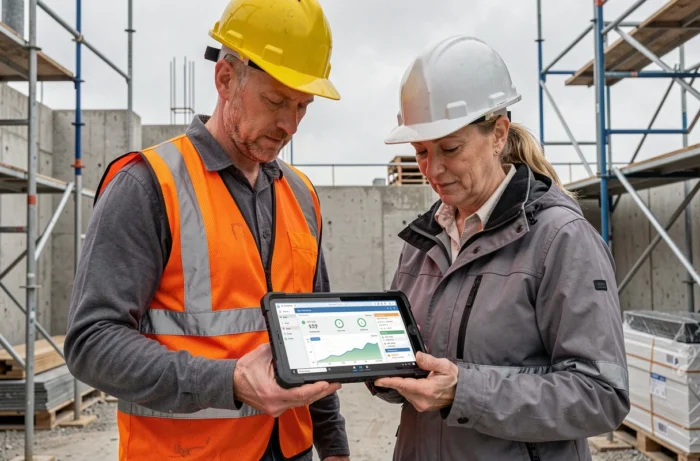
Software comparisons focus on the monthly subscription price or the license cost. This approach overlooks several items that weigh on the actual budget:
- The time for initial setup and data migration from existing tools (spreadsheets, old ERP systems).
- The training of teams, which can take several days per employee depending on the complexity of the solution.
- The integration cost with existing third-party tools (accounting, CRM, document management).
- Maintenance and regulatory updates, particularly to keep up with changes to RE2020.
A software whose license appears advantageous but requires specific developments to interface with the existing information system can end up costing significantly more over three years. The relevant selection criterion remains the ratio between the total cost of ownership and the measurable reduction in budget overruns on ongoing projects.
Centralization of Project Data and Time Savings
The centralization of documents (contracts, work orders, acceptance reports, situations) in a single tool eliminates duplicates and version errors. For a developer managing multiple simultaneous projects, this operational gain translates directly into hours saved by project managers, who spend less time searching for information and more time managing projects.
The question of real estate development software is not just a technical choice. It is an economic decision that impacts the profitability of each project. Developers who accurately measure the gap between their projected budget and their final budget, project by project, have the only reliable indicator to assess whether their management tool is fulfilling its function.


