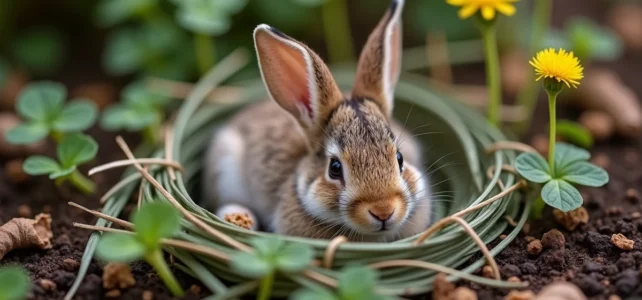
A baby rabbit motionless in the middle of the lawn, eyes open, with no sign of a mother nearby. The scene prompts intervention, but the majority of baby rabbits found in a garden are not abandoned. The mother rabbit (wild rabbit) adopts a behavior of deliberately distancing herself from the nest to avoid attracting predators. Distinguishing between a true abandonment and normal maternal behavior requires some concrete checks before any handling.
String Test on the Nest: Check for the Mother Rabbit’s Passage
The wild rabbit visits her burrow or surface nest only once or twice a day, often at night. Observing the nest during the day does not allow for a conclusion of abandonment.
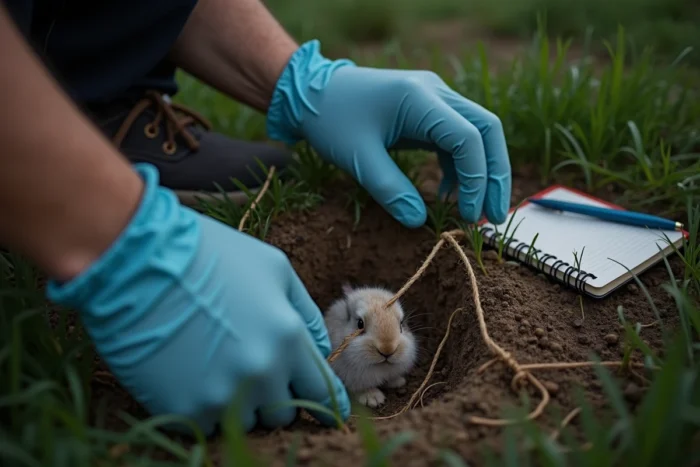
A verification method recommended by wildlife rescue centers involves placing four strands of string in a cross over the nest, then returning about twelve hours later. If the strings have been moved, the mother has passed by: the baby rabbit is not abandoned.
This test avoids a common mistake: picking up a healthy young rabbit and depriving it of maternal milk, the only food suitable for its survival during the first weeks. Before proceeding, it is possible to consult X Anima for baby rabbits to confirm the procedure according to the estimated age of the baby rabbit.
| Observed Situation | Interpretation | Recommended Action |
|---|---|---|
| Baby rabbit with eyes open, ears upright, smooth fur | Normal behavior, mother voluntarily absent | Do not touch, perform the string test |
| Strings moved after 12 hours | The mother has returned | No intervention, leave the nest in place |
| Strings intact after 12 hours | Probable abandonment or mother dead | Contact a wildlife rescue center |
| Injured, cold baby rabbit, covered in flies or larvae | Health emergency | Warm up, contact a veterinarian or immediate center |
| Nest destroyed (mowing, work, dog) | Nest compromised but mother potentially alive | Rebuild the nest on site, perform the test |

Signs of Emergency in a Baby Rabbit Found in the Garden
The string test does not apply when the baby rabbit shows signs of physical distress. Several indicators require prompt care.
- Visible injuries (open wound, deformed limb, scratch or bite marks from a cat or dog): the risk of infection is high in such a small animal.
- Presence of flies or larvae on the body: sign of myiasis, an emergency that can be fatal within hours.
- Cold body to the touch, lethargic baby rabbit or one that does not react to stimuli: hypothermia or advanced dehydration.
- Destroyed nest with visible mortality around (dead siblings): the litter is compromised.
In these cases, the first action is to place the baby rabbit in a container lined with fabric, sheltered from the wind, without attempting to feed or hydrate it. Inappropriate feeding or forced hydration can cause a fatal aspiration in an animal of this size.
Do Not Make the Mistake: Feeding a Baby Rabbit Yourself
Never give food or water to a found baby rabbit. Cow’s milk, kitten formulas, or soaked bread cause serious digestive issues. Only a rescue center or veterinarian has the equipment and formula suitable for a wild baby rabbit.
The instinct to feed comes from good intentions, but it remains the leading cause of mortality among baby rabbits taken in by individuals, according to feedback from wildlife rehabilitation facilities.
Protecting a Rabbit Nest During Mowing or Gardening Work
A wild rabbit nest in a garden looks like a slight depression in the ground, lined with fur and dry grass. It easily goes unnoticed during mowing.
A turned plastic laundry basket serves as an effective temporary barrier to protect the nest while mowing. Simply place it over the nest, mow around it, and then remove it immediately afterward. The mother will return the following night if the nest has not been disturbed beyond this protection.
Temporarily keeping a dog away from the perimeter also reduces the risk of destroying the burrow. Dogs do not seek to attack baby rabbits out of aggression but out of digging instinct. A simple physical barrier for a few days is enough to allow the litter to grow.
Autonomous or Still Dependent Baby Rabbit: Size Criteria
A baby rabbit that reaches the size of a softball (about the size of an adult’s closed fist), with ears standing upright and a full coat, is generally independent enough to survive without the mother. At this stage, it leaves the nest on its own and begins to feed on grass and vegetation.
In contrast, a smaller baby rabbit, with eyes still closed or barely covered in down, is completely dependent on maternal milk. The difference between these two stages radically changes the course of action.
When to Contact a Wildlife Rescue Center
If the string test indicates abandonment, if the baby rabbit is injured, or if it is a very young animal (eyes closed, no fur), the relay must be passed to a wildlife care center. In France, the LPO and other local organizations direct to the nearest center. A prior call can confirm whether the center accepts baby rabbits and provide appropriate transport instructions.
Keeping a wild baby rabbit at home is prohibited: the wild rabbit is a species whose possession by an individual is not allowed. Care by an authorized center remains the only legal and safest route for the animal.
The most common scenario remains that of a healthy baby rabbit, temporarily alone, whose mother returns at night. Performing the string test, keeping domestic animals away from the perimeter, and resisting the urge to touch the nest cover the vast majority of situations encountered in a garden.