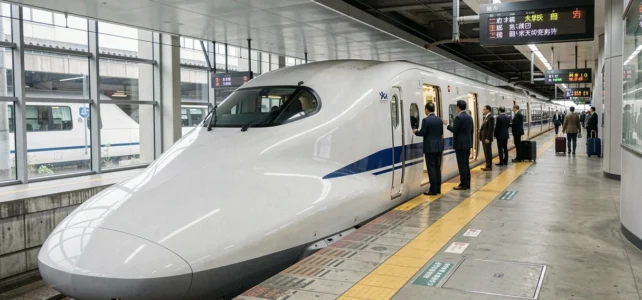
The TGV and the Shinkansen currently operate at very similar commercial speeds. Both systems peak around 320 km/h on their most efficient sections, making any direct comparison more nuanced than it seems. The answer depends on what is being measured: absolute peak, speed in daily operation, or overall performance of a door-to-door journey.
Maximum operational speed: a narrower gap than one might think
The fastest Shinkansen in regular service runs on the Tohoku line, where the E5 and H5 trains reach 320 km/h on certain sections. This is exactly the same speed as the latest French TGVs on the high-speed lines (LGV).
However, the most iconic line in Japan, the Tokaido Shinkansen between Tokyo and Shin-Osaka, remains limited to 285 km/h in operation. The fastest Nozomi covers this route in 2 hours and 21 minutes, a remarkable time considering the distance and number of stops. A detailed comparison of Shinkansen vs TGV speed on Voyagoo allows for a visual representation of these differences line by line.
On the French side, recent TGVs like the TGV M have been designed to maintain 320 km/h without aiming for higher speeds. The industrial goal stated by SNCF is no longer the race for peak records, but the optimization of the trade-off between speed, energy consumption, and wear on infrastructure.
Absolute rail record: a gap between testing and commercial reality
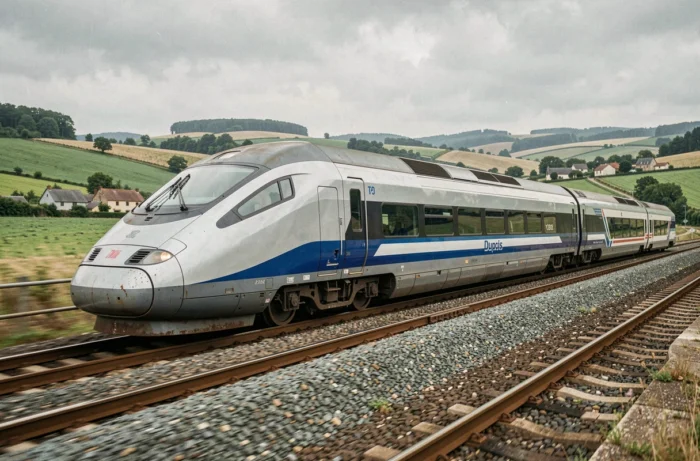
The world speed record on rail belongs to the TGV. In 2007, the V150 train reached 574.8 km/h during a test on a specially prepared section of the LGV Est. This figure remains unmatched for a train on conventional wheels.
This record says little about the daily experience of travelers. The train used was lightened, the section prepared, and the overhead line reinforced. No commercial service has ever approached this speed, nor is any intended to. A test record measures the capacity of a system pushed to its limits, not the performance of a rail network.
Japan has never really sought to break this record on conventional rail. Its long-term strategy focuses on another technology: magnetic levitation.
Chūō Shinkansen maglev: Japan’s technological breakthrough
The next real leap in rail speed will likely come neither from the TGV nor from the conventional Shinkansen. The Chūō Shinkansen project, a maglev line connecting Tokyo to Osaka, aims for a commercial speed of 500 km/h.
This technology relies on magnetic levitation: the train floats above the track, eliminating the wheel-rail friction that limits conventional trains. The available data does not allow for a reliable service start date. The project has accumulated delays, particularly with the tunneling under the Japanese Alps, and the costs of this megaproject are substantial.
France currently has no comparable program at this stage. China, on the other hand, is developing its own maglev prototypes and has already presented the CR450, a conventional train designed to significantly exceed 300 km/h in operation. The global landscape of high-speed rail is reshaping around three poles, and the historic TGV-Shinkansen duo is no longer the only contender.
What raw speed does not measure
Comparing two trains solely by their peak speed or maximum line speed is akin to comparing two cars by their speedometer. The actual performance of a high-speed network depends on factors that the speed figure does not capture:
- The frequency of services: the Tokaido Shinkansen offers departures every few minutes during peak hours, a cadence that the TGV does not achieve on any French line.
- Punctuality: the Japanese network shows average delays of only a few tens of seconds per year, a level that SNCF does not claim.
- The door-to-door travel time, which includes access to the station, transfers, and checks: on this criterion, the density of the Japanese network and the location of stations in city centers work in favor of the Shinkansen.
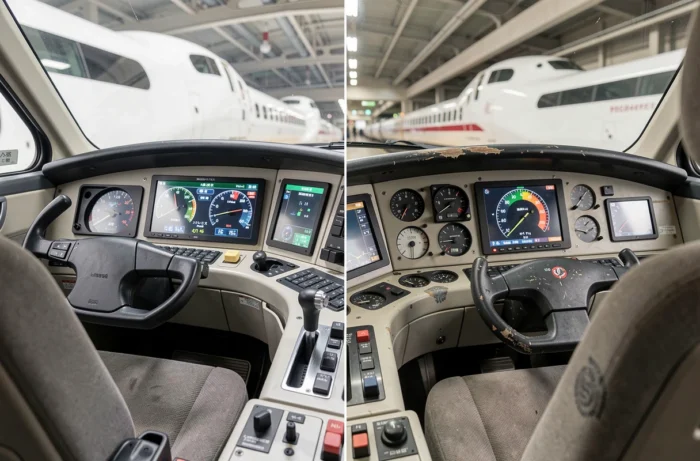
Comparative assessment of TGV and Shinkansen: speed, technology, network
| Criterion | TGV (France) | Shinkansen (Japan) |
|---|---|---|
| Maximum operational speed | 320 km/h | 320 km/h (Tohoku) / 285 km/h (Tokaido) |
| Absolute rail record | 574.8 km/h (test, 2007) | Not comparable (maglev strategy) |
| Next generation | TGV M (320 km/h, energy optimization) | Chūō Shinkansen maglev (target 500 km/h) |
| Industrial approach | Trade-off speed/energy/cost | Technological breakthrough (magnetic levitation) |
On paper, neither train is objectively faster than the other in commercial service. The TGV holds the absolute rail record, while the Shinkansen boasts unmatched punctuality and frequency. Both networks have reached a technical plateau around 320 km/h, and their evolution strategies diverge significantly.
The real decision is no longer about maximum speed. The reliability of the network, frequency, and overall travel time weigh more for a real traveler than a few kilometers per hour of difference on a given stretch. The next decade will reveal whether the Japanese maglev transforms this balance, or if global high-speed rail remains firmly anchored around this threshold.